Anchored Time, Moving Cargo
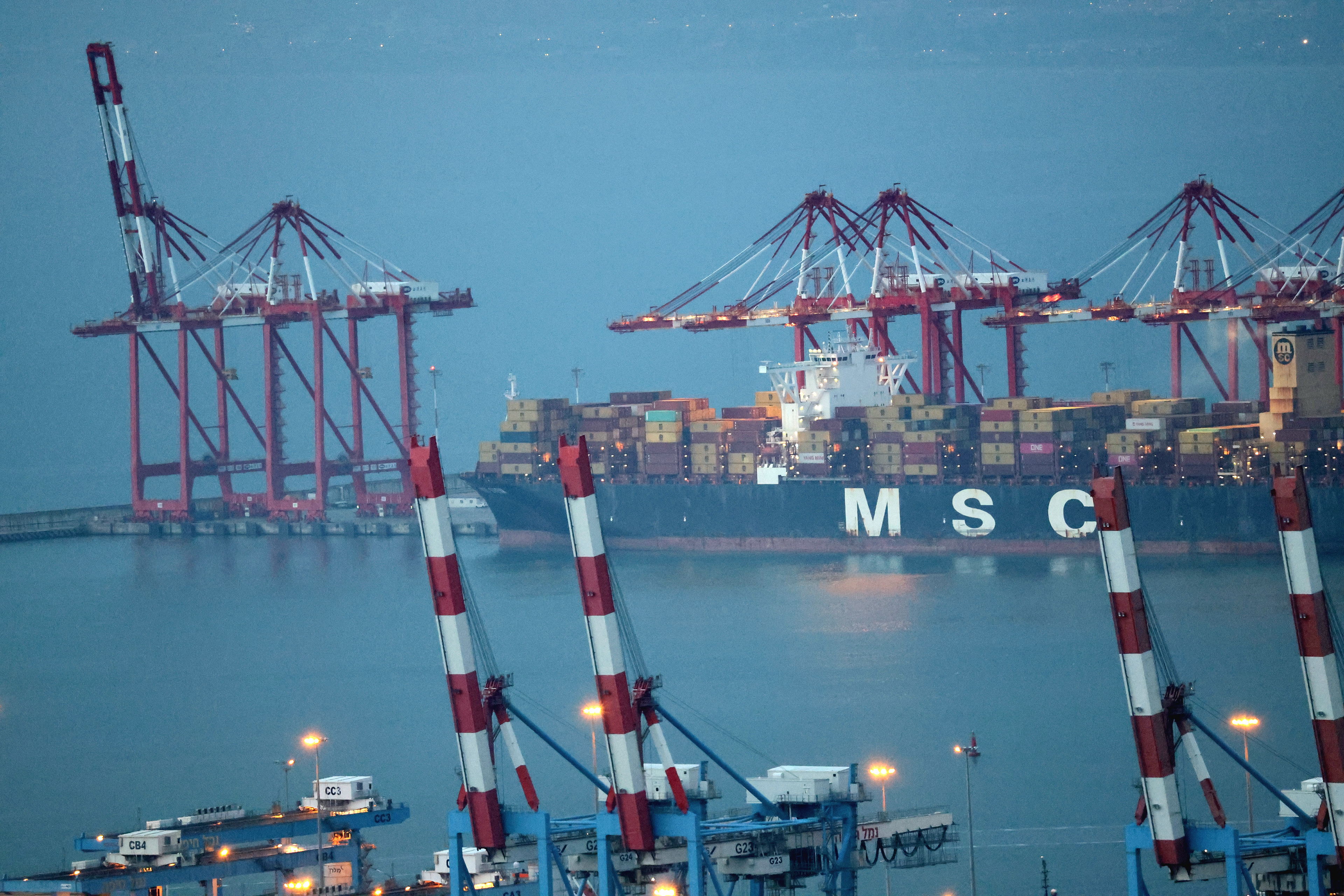
The photograph settles into view like a held breath at dusk. A container ship marked with oversized white letters drifts sideways across the frame, not really moving yet somehow already gone, its stacked containers forming a dense, pixelated skyline of trade. Towering gantry cranes rise behind it, skeletal and patient, their red-and-white arms frozen mid-gesture as if time itself told them to stop right there. The water below is calm, almost indifferent, reflecting faint industrial lights that blink on one by one, not dramatically, just doing their job. In the foreground, angled crane booms cut diagonally through the image, closer, heavier, slightly out of sync with the background—as if the scene is layered in time, not space.
This is what industrial time looks like when it slows down. Shipping is supposed to be about speed, efficiency, optimization, schedules measured in hours and port windows shaved to minutes. Yet here everything feels suspended, waiting for its turn. Containers sit stacked in rigid grids, each one carrying its own clock: production deadlines, delivery promises, contractual penalties, seasonal demand. The ship itself is a floating archive of time-sensitive decisions made months earlier—orders placed, routes planned, fuel hedged—now condensed into this quiet moment between arrival and departure. Nothing dramatic is happening, and that’s exactly the point. Most of global time passes like this, unnoticed, humming softly in the background.
The cranes are the true timekeepers in the frame. They don’t rush; they don’t drift. They repeat the same movements day after day, year after year, marking time through cycles rather than dates. Lift, move, lower. Pause. Repeat. Their scale makes human urgency feel almost irrelevant. People work here, of course, but they’re invisible in this image, absorbed into systems that operate on shifts, rotations, and synchronized logistics software. The light suggests early evening or early morning—one of those in-between hours when clocks technically advance but life feels paused, when yesterday hasn’t fully let go and tomorrow hasn’t fully arrived.
What makes the image quietly powerful is how it compresses multiple tempos into one frame. The ship belongs to global time, stretched across oceans and time zones. The port belongs to local time, governed by labor rules, tides, and infrastructure. The cranes belong to mechanical time, precise and indifferent. And the water, soft and unbothered, belongs to geological time, where all of this is a brief flicker. You can almost feel these layers rubbing against each other, slightly misaligned, like gears that never fully click.
For a site obsessed with time, this scene is a reminder that time doesn’t always announce itself with clocks or calendars. Sometimes it shows up as waiting steel, stacked cargo, and lights turning on because it’s simply that hour again. Nothing here is urgent, yet everything matters. The ship will leave, the cranes will move, the containers will scatter across continents, and this exact configuration will never exist again. It’s not dramatic time, not historical time—just operational time, quietly doing the work that keeps the world stitched together. And then, without ceremony, it passes.
Transportational.com: