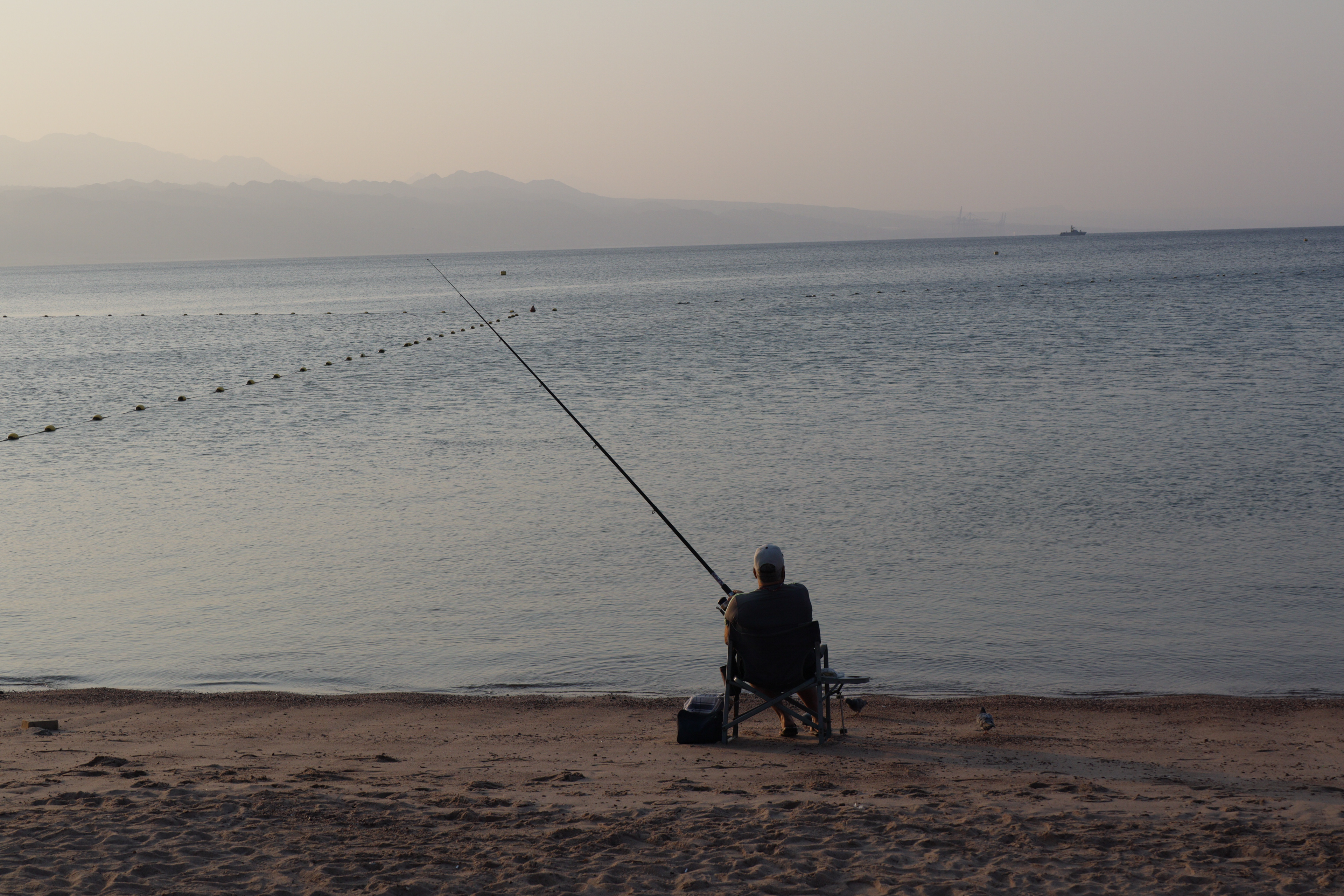
Consider this image as a photographic exercise in restraint and structure rather than narrative. Start with the horizon: it sits high in the frame, compressing sea and sky into a single pale gradient where distant mountains dissolve into atmospheric haze. Use that softness deliberately; the low contrast suggests early morning or late afternoon, when light flattens detail and rewards patience. The main compositional line is the fishing rod, cutting diagonally from the seated figure toward the open water. It’s thin, almost fragile, yet it anchors the entire frame, guiding the eye outward and preventing the scene from collapsing into empty space. Notice how the buoys form a secondary rhythm, a dotted horizontal line that quietly counterbalances the rod’s diagonal tension. The fisherman himself is small, centered low, back turned — a study in negative space and scale, where the subject exists less as an individual and more as a measure of distance and time. Even the sand matters here: footprints, slight depressions, and uneven texture add a grounded foreground, reminding you that this is not abstraction but lived terrain.