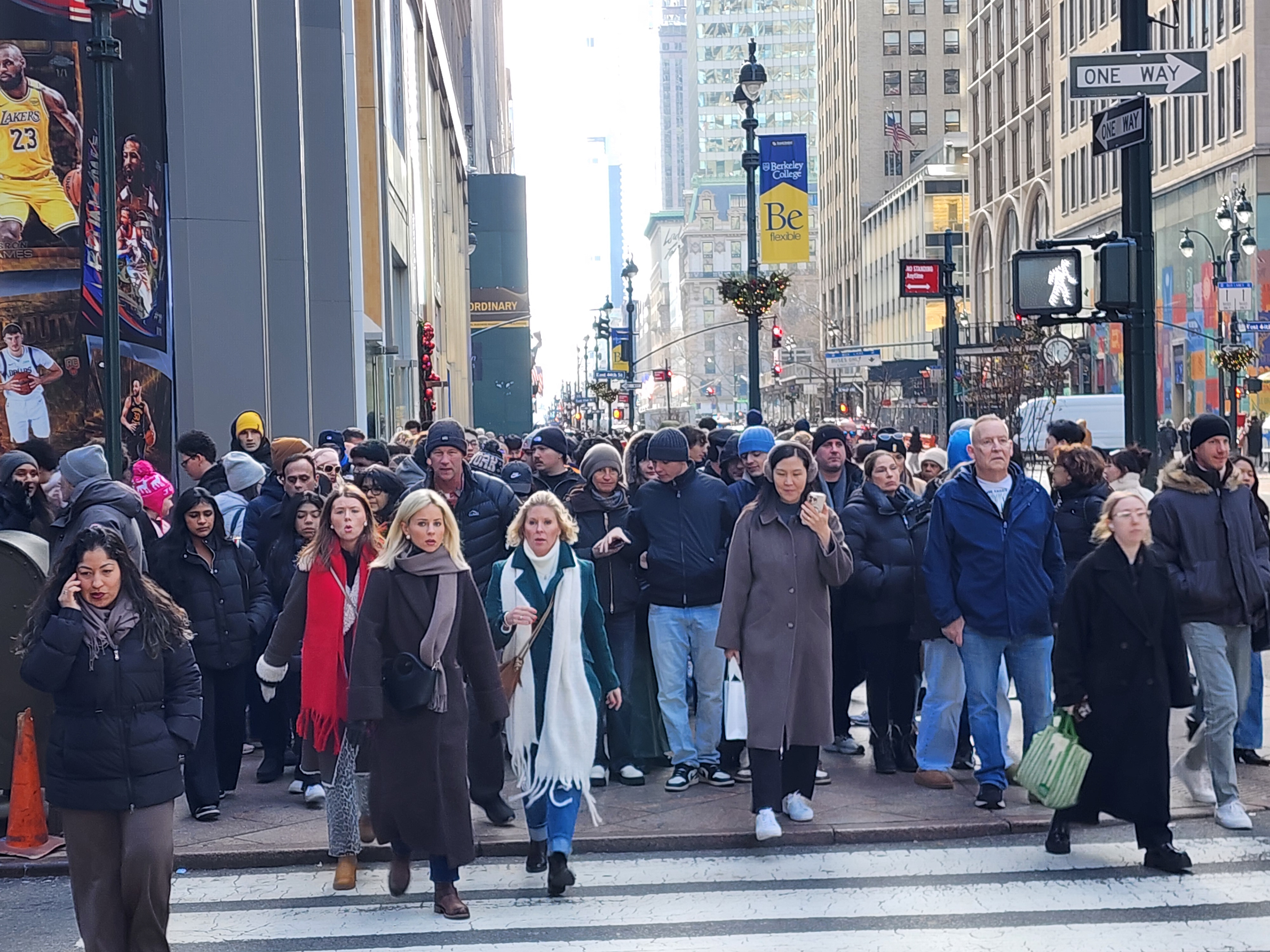
A wall of people spills forward at the exact moment the signal flips, the white walking icon glowing above like a starting gun. The frame catches that split second when hesitation disappears and motion becomes collective—dozens of individuals stepping off the curb together, each with their own destination, their own internal timeline, yet temporarily synchronized by the logic of the street. It’s winter in the city, you can feel it in the layers: thick coats, scarves wrapped high, knit hats pulled down just enough to leave eyes exposed to the cold brightness bouncing between buildings.
The composition compresses everything. Tall facades on both sides create a corridor of light that narrows toward the distance, pulling the eye through banners, traffic signals, and storefront reflections. A Berkeley College banner hangs mid-frame, almost like a soft interruption in the grid of steel and glass, while “One Way” signs stack in the upper right, quietly dictating flow in a scene that otherwise feels chaotic. On the far left, a vertical billboard featuring a basketball player—mid-action, frozen in performance—adds another layer: motion inside motion, spectacle embedded in routine.
Faces in the front row carry the story. A woman in a deep red scarf cuts through the palette like a deliberate edit, beside her a blonde woman in a long dark coat, eyes forward, expression set somewhere between focus and fatigue. Another figure glances down at a phone while walking, already half-absorbed in a parallel stream of information. To the right, a man in a blue jacket steps forward with a kind of practiced indifference, a shopping bag swinging slightly out of rhythm with his stride. No one is posing, no one is waiting—the movement is the message.
As a media digest hero image, it leans into density rather than spectacle. There are no towering screens here competing for attention, no singular focal point demanding interpretation. Instead, the image reflects throughput—human bandwidth in its rawest form. Information, intention, distraction, routine, all crossing at once. The city doesn’t pause to narrate; it processes. And for a brief moment, standing at the edge of that crosswalk, everything aligns just enough to move forward together… then immediately fragments again.
Media Digest: