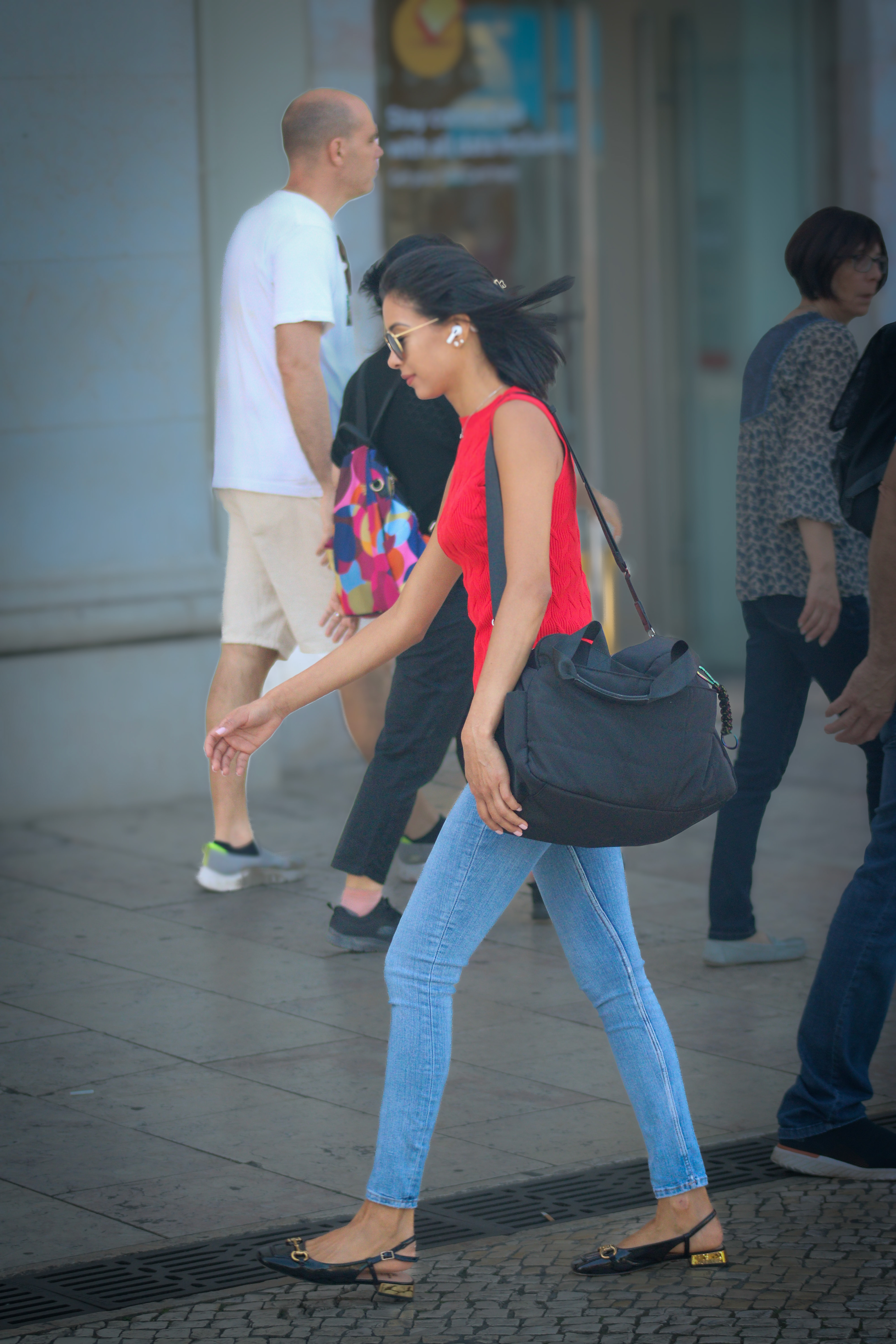
A single figure cuts through the frame with that unmistakable sense of purpose you only catch when everything aligns for a split second—the stride, the light, the contrast, even the wind playing its part. She’s mid-step, leaning slightly forward, the kind of walk that suggests she knows exactly where she’s going and doesn’t intend to slow down for anything. The red sleeveless top immediately anchors the image, almost vibrating against the otherwise muted palette of pavement greys, washed-out walls, and soft background tones. It’s not just color—it’s intent, maybe even attitude.
Her hair is caught in motion, swept back by a passing breeze or just the speed of her movement, and those small details matter more than they should. The wireless earbuds, the sunglasses, the black shoulder bag slung with casual precision—everything feels unforced, but also perfectly assembled. It’s that modern urban uniform, somewhere between function and expression, where even the smallest accessory tells you something about the rhythm of her day. You get the sense she’s tuned into her own world, soundtracked, insulated, moving through the city like it’s a familiar current.
What makes this frame work, though, is the layering. Behind her, life continues without coordination. A man in a white T-shirt drifts in the opposite direction, slightly out of sync, almost like a different timeline intersecting for a moment. Another passerby carries a colorful bag that briefly echoes the vibrancy of her red top, but then fades back into the blur. On the right, figures dissolve into shadow and softness, reinforcing that subtle separation between subject and environment. It’s not isolation—it’s emphasis.
The ground tells its own story too. The transition from smooth pavement to textured stone near the edge adds a tactile shift, almost like a visual punctuation mark at the bottom of the frame. Her step lands right on that boundary, which, whether intentional or not, creates a small narrative tension—movement across surfaces, across moments, across contexts.
From a shooting perspective, there’s that slightly compressed look, likely a longer focal length, which flattens the scene just enough to keep everything tight while still allowing the subject to breathe. The shallow depth of field isolates her without completely erasing the surroundings, and that’s the balance street photography constantly chases—context without clutter, presence without noise.
And maybe that’s what lingers after looking at this image for a while. It’s not just about a woman walking down a street. It’s about how cities are built from these fragments—brief crossings, overlapping paths, people who will never meet but share the same slice of time for a fraction of a second. You catch one of those moments, frame it right, and suddenly it feels like it mattered more than it probably did. Or maybe it did matter. Hard to say.