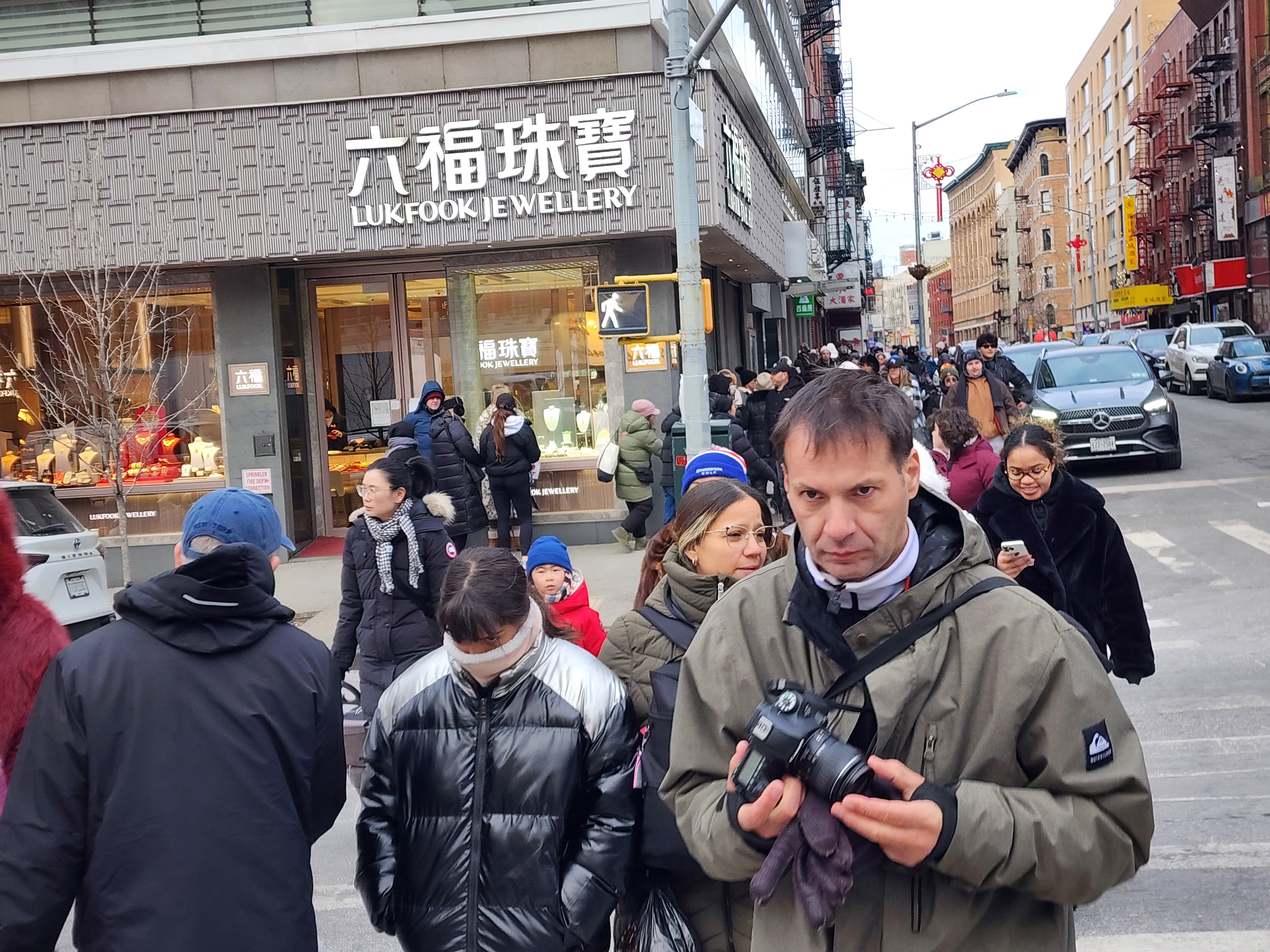
The frame looks innocent at first, almost cheerful in that messy, honest way only a city corner can manage. A jewelry store glows behind glass, warm light bouncing off gold and red displays, Chinese characters sitting proudly above the entrance like a quiet announcement of history and commerce continuing as usual. The crosswalk is packed, bodies layered in winter jackets, hats, scarves, hands buried deep in pockets, everyone mid-motion, mid-thought, mid-day. Then your eye hits the man in the foreground, camera in hand, looking straight back, not angry exactly, but alert, focused, caught in that split second between being the observer and realizing he has become the observed. And that’s where the trouble begins, or at least where it always might begin.
Street photography lives in that fragile zone between documentation and intrusion. You raise the camera for a fraction of a second, chasing light or geometry or the way people flow through space, and suddenly the entire social contract shifts. The photographer becomes visible, and visibility changes everything. In this image, you can almost feel the moment collapsing inward: the crowd still moving, the photographer pausing, the invisible question hanging in the air — did you just take my picture, and why? The street doesn’t stop, but something in the atmosphere tightens. Faces turn down, away, or straight into the lens. A kid in a red jacket stares blankly. Someone checks their phone, pretending not to notice. The whole scene is a small lesson in how quickly control slips away when you work in public space.
What can go wrong isn’t just confrontation, though that’s the obvious fear. It’s the loss of flow, the way a scene dies the moment awareness enters it. It’s the ethical hesitation that hits after the shutter clicks, when you replay the moment and wonder if you took more than you should have. It’s also practical stuff: blocked shots, ruined compositions, tense exchanges, or simply the feeling of being exposed when you were supposed to be invisible. And yet, oddly enough, these risks are also what make street photography matter. This photo holds that tension perfectly — a photographer photographing, being photographed, surrounded by people who didn’t sign up for any of it, all wrapped in a single crowded intersection. The street always wins in the end, but it lets you borrow its chaos for a moment, if you’re quick and a little brave, and maybe ready for things to go slightly wrong.
Related